
I KNEW IT!!! Handwriting Is Doing More Than We Think
Helene Lieberman MS, OTR/L www.blackbackhandwriting.com

As a pediatric occupational therapist who has worked with children for more than 38 years, I’ve always believed that there is something very special about putting a pencil in a child’s hand and actually writing. Now, research has again proven me right!! Research is giving us even more evidence that handwriting is doing much more than putting letters on paper.
With technology becoming such a huge part of our everyday lives, children are spending more and more time typing, tapping, and swiping. Of course, technology has an important place in education. But this research makes me ask: What are we giving up when handwriting is replaced by typing?

In “Handwriting but not typewriting leads to widespread brain connectivity: a high-density EEG study with implications for the classroom” (van der Weel & van der Meer, 2024), researchers studied 36 university students while they wrote words by hand using a digital pen and typed the same types of words on a keyboard. While the students were doing these activities, researchers recorded their brain activity using EEG technology.
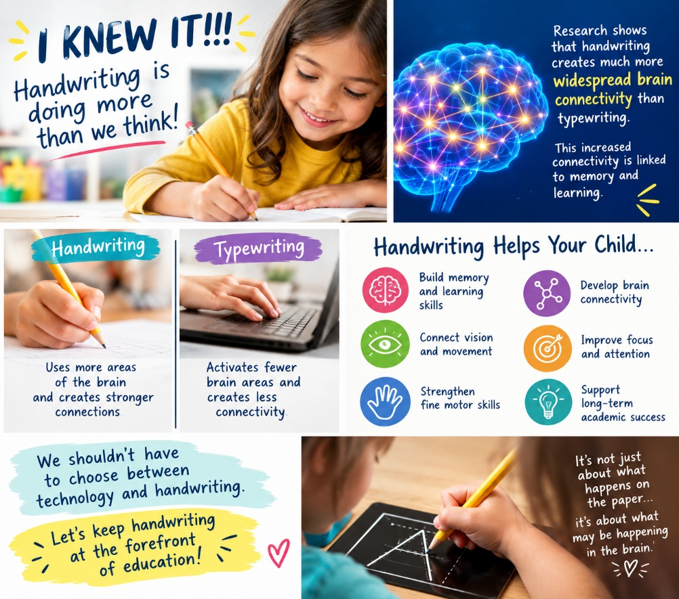
Guess what? The brain was much more connected and active when the students were writing by hand than when they were typing. When the students wrote by hand, researchers found more complex patterns of communication between different areas of the brain, particularly areas involved in movement, vision, and processing information. These patterns are important because they are associated with memory and learning. I have been seeing this for years!!
Why Does Moving the Hand Matter?
Think about what happens when a child writes a letter. The child isn't simply looking at a letter.
They are:
👀 Looking at the letter
✋ Moving the hand
✏️ Controlling the pencil
🧠 Remembering how the letter is formed
👁️ Watching where the pencil is going
🤲 Feeling the movement through the hand and fingers
🔄 Coordinating all of these things together
That's a LOT of information going into the brain! Writing requires precisely controlled movements. At the same time, the brain is receiving visual and proprioceptive information—information about where the hand and fingers are moving. The movement itself becomes part of the learning experience.
Typing is different. When we type a word, we can press a key with a finger and immediately produce the letter on the screen. The physical movement involved in forming the actual letter is greatly reduced. This Is Why I Keep Saying: Handwriting Matters! For years, I've watched children struggle with handwriting and have seen how important the physical act of forming letters can be. This research reinforces something I have believed throughout my career: Handwriting isn't just about learning how to write.
I am NOT saying we should get rid of technology. Technology is here to stay—and there are many wonderful ways that computers, tablets, and other digital tools can support children's learning. We need both handwriting and technology.
If your child is struggling with handwriting, don’t give up!! Make the handwriting task simpler. BlackBack Handwriting is easy to use has many unique features not found in other handwriting programs and can be customized to a child’s needs.
• BlackBack Handwriting is the only handwriting system using the negative space of the page: images are white on a black background. This increases focus and decreases reversals.
• BlackBack Handwriting allows the user to see their strokes as they use the negative/ white space and get minimal or no visual feedback when not writing correctly. This eliminates the need for language and promotes error-free learning.
• BlackBack Handwriting has only one image on the page, eliminating distraction and increasing attention to the task.
• BlackBack Handwriting is the only handwriting program with 4 varied sizes of each upper- and lower-case letter, shape, and number. This develops fine motor coordination.
• BlackBack Handwriting has laminated cards that be used repeatedly with dry-erase writing tools and sensory media. This is perfect for those needing multiple exposures and multi-sensory learning experiences.
Try it with a free sample at www.blackbackhandwriting.com and let me know what happens!
Let's keep those hands moving and keep handwriting where it belongs—at the forefront of education.
van der Weel, F. R., & van der Meer, A. L. H. (2024). Handwriting but not typewriting leads to widespread brain connectivity: A high-density EEG study with implications for the classroom. Frontiers in Psychology, 14, Article 1219945. https://doi.org/10.3389/fpsyg.2023.1219945


Comments